
If you have any interest in literature and have studied it at all, you probably already know about animal symbolism and trickster figures throughout folklore. If you don’t, then basically what you need to know is that throughout history, animal symbolism has been used as a vehicle for moral education, political commentary, and cultural identity.
Foxes: Tricksters and Foes
Throughout folklore foxes appear as tricksters that are eager to get the upper hand on humans and their companions. In Whynne, it is no different, with legends of fae foxes leading humans to ruin via clever wording and obstruction of the truth.
Their reputation for stealing from fields, capitalizing on eager young maidens, and making a fool of just about everyone that they come across does, of course, have its consequences and a common myth in Whynne poses that if one were to catch a fox, any kind, and let them live then the Fox would grant you a wish through whatever means available to them.
At one point this was so widely believed that it led many foxes to hide within the woods of Whynne, trying to avoid the arms of whatever desperate souls happened to come across them; fae or not.
After all, a simple fox cannot grant any sort of wish, or can they?
The Wild Fae of Whynne
Common in fae folklore is the idea of fae shapeshifting to take the form of another animal, or simply appearing in that form all the time. This is true in Whynne as well, but the degrees of ones animalism and magical ability affects the classification of a fae..
Let me explain.
So, all wild fae are by definition Seelie as the majority are capable of surviving in the light and tend to have less monstrous appetites. But in order to qualify as a high Seelie, one needs to have both a high amount of magic and a vaguely humanoid appearance.
And so, taking into account one of my favorite characters, Finn, who is a wild fae with mixed heritage that presents as a humanoid with horns and taking into account Rory, the star of the latest novella who presents as human but has the ability to shift into a fox (and a high amount of magic as a result), let me give you this graph.
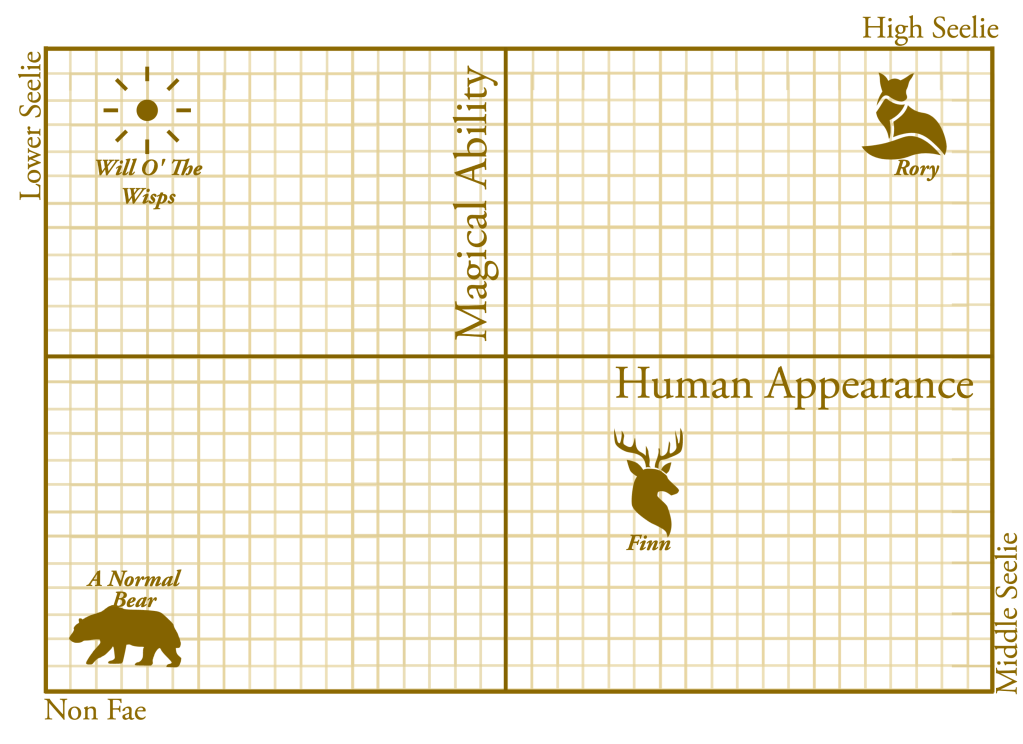
And so, taking into account the fact that wild fae appearances can be vary from being human-like with distinctly animal features to basically being a fox walking on two legs, you can sort of get the idea that the wild fae are a massive category of fae.They also break down further, with wild fae groups having their own townships and clans and rulers and so forth.
In the case of Rory, the wild Fae in Bride of the Fox King, Rory operates as an extremely powerful wild fae who has been put in charge of regulating other fox fae. Think of his position sort of as a combination governor and sheriff. The wild fae have these because Whynne is a massive country that is populated by an assortment of fae, which can make things difficult to manage.
If you want to learn a little more about Whynne and see some small glimpses into life in the Kingdom of Whynne, check out the World of Whynne, my series of Novellas about it! The Gancanagh’s Bride is out now, and the Bride of the Fox King (starring Rory) comes out later this month with a cover reveal coming on my instagram.

 B. A. Lovejoy